

Right to Withdraw (EU Cooling-Off Period)
The Right to Withdraw automation helps you comply with the European Union’s statutory cooling-off period for online (distance) and off-premises sales. When enabled, eligible EU customers can withdraw from their purchase and return their order for a refund, directly from the Corso customer portal.
This article is the authoritative reference for how Corso implements the right of withdrawal. It is intended to help you configure the automation correctly. It is not legal advice — consult your own counsel for guidance specific to your business.
Legal Basis
Section titled “Legal Basis”The right of withdrawal is established by the EU Consumer Rights Directive (Directive 2011/83/EU) and applies across all 27 EU member states. For distance and off-premises contracts, consumers may withdraw from a purchase within 14 calendar days, without giving any reason and without justification.
- Goods — the 14-day period starts the day after the customer (or a third party they nominate) receives the goods. For an order delivered in multiple shipments, it starts the day after the last item is received.
- Services & digital content — the period generally starts the day after the contract is agreed.
- Deadlines on non-working days — the period is counted in calendar days, but per the European Commission, “If the cooling-off period expires on a non-working day, your deadline is extended until the next working day.” This working-day extension is a requirement of the right, not an optional courtesy.
- Returning the goods — after notifying the merchant of their decision to withdraw, the customer has a further 14 days to send the goods back.
- Refunds — the merchant must refund within 14 days of being informed of the withdrawal, including the standard delivery cost of the original order. The merchant may withhold the refund until the goods are received back (or the customer provides proof of return).
Who pays for return shipping?
Section titled “Who pays for return shipping?”By default, the customer is responsible for the direct cost of returning the goods, unless the merchant has agreed to bear that cost or failed to inform the customer that they would be responsible for it before purchase. Where an item is defective, the merchant is responsible for the return shipping cost. See How Corso handles return shipping below. You should ensure that this is fully outlined on your site so that a customer is made aware of any obligations they or you have in accordance with EU law.
When the right does not apply
Section titled “When the right does not apply”The right of withdrawal does not apply to certain categories, including:
- Custom-made or clearly personalized goods
- Perishable goods or goods with a short expiry
- Goods unsealed after delivery that are not suitable for return on hygiene or health grounds
- Sealed audio/video recordings or software that have been unsealed
- Digital content already downloaded or streamed (where the customer expressly consented and acknowledged losing the right)
- Goods whose price depends on financial-market fluctuations
- Newspapers and magazines (except subscriptions)
- Transport, accommodation, car rental, and leisure bookings for a specific date
- Urgent repairs or maintenance the customer specifically requested
12-month extension
Section titled “12-month extension”If the merchant does not inform the customer of their right of withdrawal, the withdrawal period is extended by up to 12 months from the end of the original 14-day period. If the merchant provides the missing information at any point during those 12 months, a fresh 14-day period begins from the day the customer receives that information.
Surfacing the right clearly — which the Right to Withdraw automation does in the customer portal — is what keeps the period at the standard 14 days. The automation is your primary safeguard against triggering the extension.
Handling the extended window in Corso
Section titled “Handling the extended window in Corso”The Right to Withdraw automation itself uses the 14-calendar-day + working-day extension window described above. To operationally honor a longer window for EU shoppers — for example, to provide a buffer against the 12-month extension, or simply to offer a more generous EU policy — use Corso’s Return and Warranty Eligibility rules, which let you adjust return, store-credit, exchange, and warranty windows for a targeted set of orders.
- Create a Return or Warranty Eligibility rule in the Automations engine.
- Add an Order country condition targeting the EU member states you want to cover (the same 27 countries listed above). Order country is a built-in condition — see Building Automation Rules.
- Set the eligibility window to the longer duration you want to honor for those countries (for example, an extended return window or warranty duration).
- Use rule priority so this EU rule takes precedence over your shorter default policy when both could apply.
How Corso Handles It
Section titled “How Corso Handles It”Eligibility conditions
Section titled “Eligibility conditions”When you add the Right to Withdraw automation, Corso automatically applies a required condition that the order’s destination country is in the EU. The automation only offers withdrawal to orders shipping to one of the 27 member states:
Austria, Belgium, Bulgaria, Croatia, Cyprus, Czech Republic, Denmark, Estonia, Finland, France, Germany, Greece, Hungary, Ireland, Italy, Latvia, Lithuania, Luxembourg, Malta, Netherlands, Poland, Portugal, Romania, Slovakia, Slovenia, Spain, and Sweden.
You can add further conditions (for example, by product or order tag), but the EU country condition is required. If you remove it, Corso restores it, and this also clears your other conditions. Keep the rule on Matches all of the following so the EU condition always applies. If more than one Right to Withdraw automation matches an order, only the one with the highest priority is used.
How the withdrawal window is calculated
Section titled “How the withdrawal window is calculated”Corso determines whether an order is still within its cooling-off period from the order’s most recent delivery date (the latest delivered fulfillment on the order). The window follows the statutory 14 calendar days, with a working-day extension when the deadline lands on a day that can’t be used:
- Start from the most recent delivery date on the order.
- Count forward 14 calendar days.
- If that end date falls on a non-working day — a weekend or a public holiday in the customer’s country — roll it forward to the next working day. This implements the EU rule that a deadline expiring on a non-working day extends to the next working day.
If the current date is on or before that computed end date, the order is eligible and the withdrawal option is shown to the customer.
The customer experience
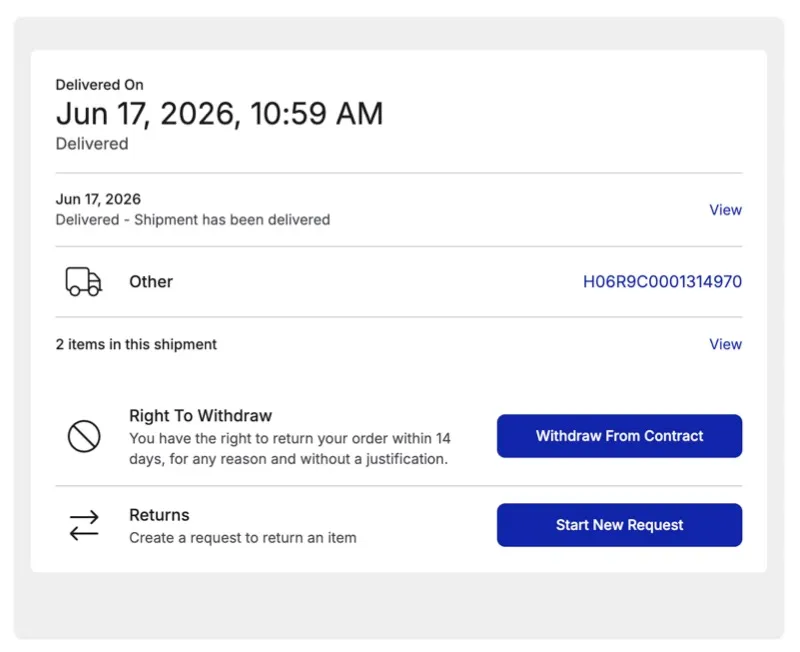
Section titled “The customer experience”When an order is eligible and no existing claim is open, a Withdraw From Contract card appears on the customer’s Order Hub page. The card displays the Title and Description you configured in the automation. Clicking Withdraw From Contract opens the withdrawal form.
- The customer clicks Withdraw From Contract on their Order Hub page.
- In the Verify your information section, they confirm the shipping address Corso will use for the return.
- In the Condition of your items section, they check An item was damaged or defective if one or more items arrived damaged, defective, or not as described.
- The customer clicks Withdraw From Contract to submit. Corso creates a return claim for the entire order (all line items, as a refund) and quotes return shipping.
Because a withdrawal returns the whole order, customers who only want to send back some items are directed to start a standard return instead. The withdrawal card is also hidden once an existing claim is already open on the order.
The withdrawal option must be made accessible to customers. This is generally understood to mean providing a clearly labeled link — such as one that reads “Withdraw from Contract” — that points customers to the return portal. A link placed in your site footer, accessible from all pages, is generally considered acceptable under the legislative guidance.
Return shipping and defective items
Section titled “Return shipping and defective items”Corso records every withdrawal with the reason Right To Withdraw, with a reason detail of Defective or Not Defective depending on the customer’s answer.
When the customer indicates an item is defective, the merchant absorbs the return shipping cost: no label charge is applied to the claim. For non-defective withdrawals, the quoted carrier label rate is deducted from the refund. No markup is added, and your Charge For Return Label rules don’t apply.
Return shipping is quoted using your Return Shipping Policy automations, so you need one that matches these orders. Corso uses a carrier label if one is quoted, then a Global-e label, then a packing slip. Global-e labels and packing slips are never charged.
Setting It Up
Section titled “Setting It Up”- Go to Settings > Automations, click Create, and choose Right To Withdraw under What would you like to do? The rule runs at Order Lookup.
- Confirm the EU country condition is present (added automatically) and add any additional conditions you need.
- Set the Title and Description shown to customers in the portal. Both are required and start with default text. The description is a good place to summarize the customer’s rights and link to your own policy.
- Save and enable the rule.
Q: Does the withdrawal window use calendar days or business days? Calendar days. The statutory period is 14 calendar days, extended to the next working day if it expires on a non-working day. Corso counts 14 calendar days from the most recent delivery date and, if that deadline lands on a weekend or a public holiday in the customer’s country, rolls it forward to the next working day. This satisfies the working-day extension the law requires.
Q: Which delivery date is used if an order ships in multiple packages? The most recent delivery date on the order. This matches the Directive, where the period for a multi-shipment order starts after the last item is received.
Q: What happens to return shipping costs? If the customer marks an item as defective, the merchant pays for return shipping. Otherwise, the quoted carrier label rate is deducted from the refund, with no markup. Global-e labels and packing slips are never charged.
Q: Can a customer withdraw only part of an order? No. A withdrawal returns the entire order for a refund. Customers who want to return only some items should start a standard return instead.
Q: Why don’t I see the withdrawal option on a non-EU order? The automation requires the order’s destination country to be in the EU. Orders shipping outside the 27 member states are not eligible.
Q: Why is the Withdraw From Contract card not appearing for an eligible customer? The card is hidden when there is already a claim on the order. If no claim is open and the order is within the 14-day window, confirm that delivery dates are correctly synced back to the Shopify order by your fulfillment provider or shipping app. An order with no recorded delivery date will not surface the withdrawal option.